Gluten-Free Bread
Without gluten the structure is missing. Psyllium husks rebuild it, and the dough is intentionally liquid.
- Preparation
- 20 min
- Cook/bake time
- 55 min
- Total
- 2 hr 45 min
- Difficulty
- Medium
- Calories
Without gluten the structure is missing. Psyllium husks rebuild it, and the dough is intentionally liquid. Gluten-free bread almost always fails because people treat it like wheat bread by kneading, shaping, and pulling it tight. None of that works. What works is a pourable dough, a loaf pan, and a binder that holds water.
Why this works
Gluten is an elastic protein network that forms during kneading and traps fermentation gases. Without it, the carbon dioxide from the yeast simply escapes upwards, and the bread remains flat. Psyllium husks replace this network in a different way. They bind up to fifty times their weight in water, forming a gel that performs the same task. It holds gas, gives the dough structure, and prevents the bread from crumbling. For this gel to form, the dough must be significantly wetter than a wheat dough. A kneadable gluten-free dough has too little water and turns into a dry brick. Kneading is actually harmful here. There is no network to align, but the gas bubbles that have already formed are destroyed in the process.
Step-by-step instructions
- 1
Mix the dry ingredients
Thoroughly mix all dry ingredients in a large bowl. The psyllium husks must be distributed really evenly. They swell immediately upon contact with water, and a lump will remain as a gel-like nest in the finished bread.
- 2
Add water and stir
Pour in the water, oil, vinegar, and sugar, and stir vigorously with a spoon for one minute. The dough is now liquid like a thick batter, and that is exactly right. A kneadable gluten-free dough has too little water and turns into a dry brick.
- 3
Let swell for ten minutes
Let the dough stand for ten minutes. During this time, the psyllium husks bind the water, and the mass becomes visibly thicker and moldable. The batter turns into a soft, sticky dough that supports the structure of the bread.
- 4
Transfer to the pan and let rise
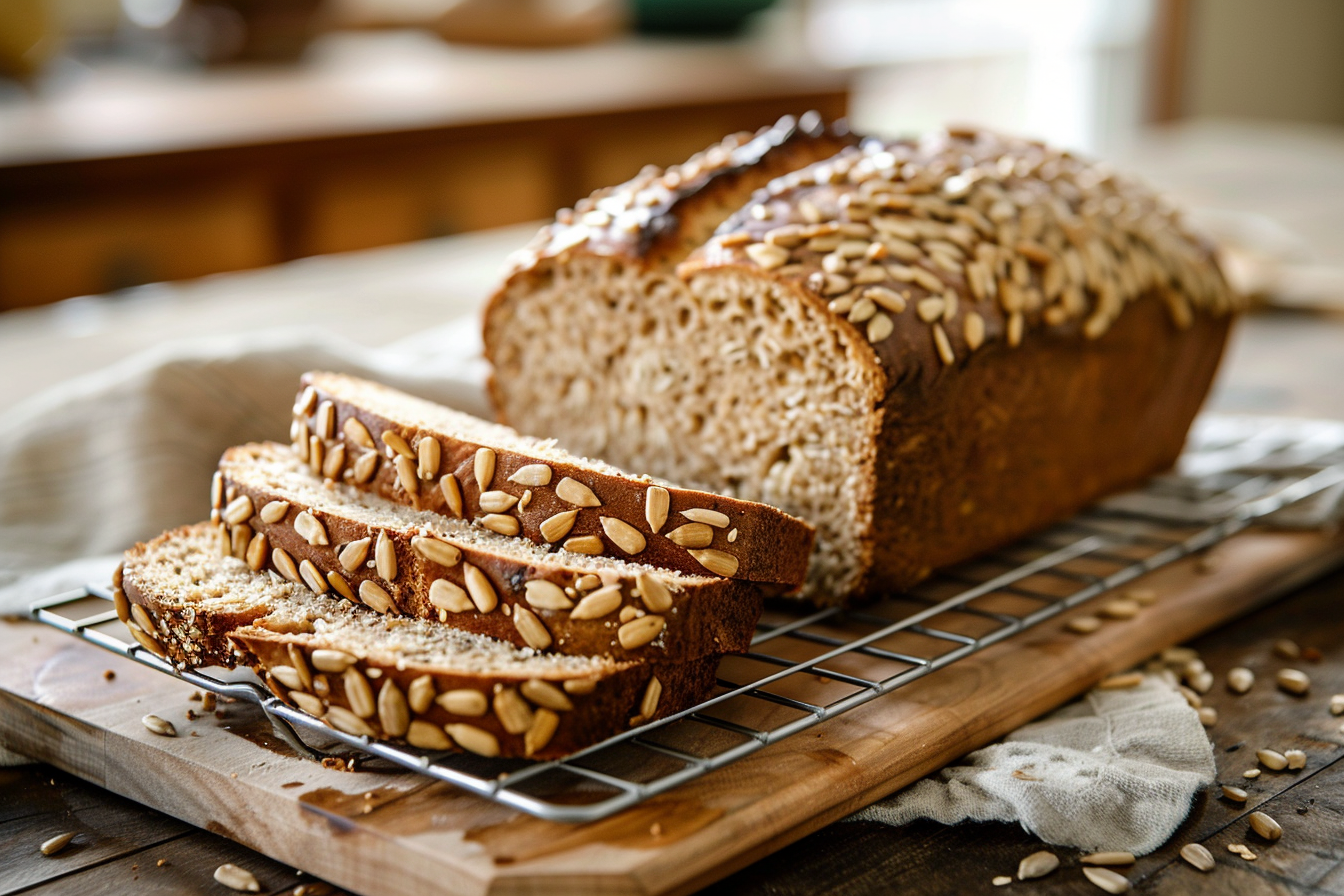
Spread the dough into a greased 30 cm loaf pan using a wet dough scraper, smooth the surface, and sprinkle the seeds on top. Let it rise covered for ninety minutes until it has visibly domed. It does not double in size like a wheat dough. A third more volume is the goal.
- 5
Bake and cool completely
Bake the bread for 55 minutes at 220 °C top and bottom heat. It is done when it sounds hollow and the core temperature is 98 °C. And now for the most important step. Let it cool completely for at least four hours. Gluten-free bread is always gummy when cut warm because the starch only finishes binding as it cools.